
You want your business to be found in Wichita and beyond. Is it? We face some weird marketing things in our community. If you do any kind of networking within Wichita, you know that we’re a city (400K in Wichita, almost 700K in the metro area) that feels like a small town. It can often seem like you have to know somebody to get any traction. That’s not true, though. I mean the reason you landed on this article from your Google search is because you are looking for not just great web design in Wichita, KS, but web design that meets ADA compliance. You know that a great website can help you break through the noise and reach more people.
But it needs to be fully accessible to reach all of your potential customers.
Before we get started, I am going to be real honest that this article may feel a bit…messy. That’s not my intention. The reality is that only 4% of the internet is actually accessible. I know several great web designers and agencies that simply do not know or understand how they build websites is causing significant issues for people.
But you, my friend, do understand. You know that your website won’t reach your entire target audience if you are actively excluding them. Knowing is the first step. How do you go about finding someone that can help you with accessible web design, local to you? Keep reading.
Table of Contents
Who Web Accessibility Helps
Your current website, or the website you pay someone over $15,000 to build for you, could be excluding potential customers.
That’s a nightmare scenario that all too many businesses are facing.
It does not matter what your website is built in, either. Whomever you hire could use WordPress, Shopify, AI, or custom code it and the result still could be that you are making your website difficult for some to use.
Before you say, “I don’t know anyone,” you are wrong. In the US alone, roughly 28.7% of people have some form of disability. That’s nearly a third of your potential customer base that may not use the internet the same way you do. Let’s put this into perspective. That number can include individuals who:
- Are blind or have low vision
- Are visually impaired
- Are deaf or hard of hearing
- Are color blind
- Have tinnitus
- Have ADHD
- Are dyslexic
- Have epilepsy
- Have neurological conditions
- Are autistic
- Struggle with arthritis in their hands
- And much more
While this is nowhere near a complete list, disabilities don’t have to be permanent, either. If you break your dominant arm, wrist, or hand, you will notice how quickly everything gets more difficult.
We have come a long way in helping people with disabilities use modern technology, but most websites still lag woefully behind. Remember how I mentioned just 4% of the internet is accessible? It’s worse than that. In the same study, they found that most website homepages average around 56.1 errors per page.
That’s a ton of roadblocks to throw up for nearly a third of your visitors.
What Accessible Agencies Should Do
You know that your website needs to do better, but what are you actually looking for an agency to do for you?
First, they need to openly discuss how they’ll meet current WCAG standards. If an agency only mentions that they meet “ADA compliance,” ask some more questions.
WCAG vs ADA
Yes, I know that I mentioned ADA compliance at the top of the article. But overall, it’s a misnomer. This may be how you have learned about it, because in the US, we have to worry about complying with the Americans with Disabilities Act. However, you may not know that, technically, no set rules apply to ADA compliance in 2026. In fact, the US government has delayed upcoming rules until at least 2027 (for now).
Courts have consistently said, however, that US businesses and organizations need to meet international accessibility standards. These are the Web Content Accessibility Guidelines (WCAG). Most international accessibility laws require websites to meet WCAG 2.1 Level AA, though 2.2 is the current recognized standard.
The W3C (which creates these standards) has released its working draft of WCAG 3.0. This means WCAG requirements may change over the next year or two.
That’s a lot of technical information to say – your agency needs to be able to explain to you that they understand WCAG standards, since they set ADA requirements.
WCAG Levels
If your agency mentions that they meet WCAG standards, ask which level. While most laws require 2.1 Level AA, there are rules in 2.2 that significantly help your customers.
Other rules under AAA guidance are integral to people understanding your website as a whole. Reading levels, for instance, are required under AAA rules. This matters more as 56% of US adults read below a 6th-grade level.
Those of us in the accessibility community know WCAG 3.0 will become the international standard sooner rather than later. That means laws may update within the next year or two to require 2.2 at minimum.
WCAG is there to guide web designers and developers, but in this case, overachieving is always a great thing.
Bare Minimum Accessibility Requirements
I understand that not all agencies have the same process, but if you are working on a new website with an agency, they should, at minimum, talk to you about a few things.
One of the easiest? Alternative text. If they do not have a discussion with you about how to properly label your images during the build (I will be honest, I do not always know what clients are providing me) or how to do it yourself after, they may not be doing it at all.
Another key thing they should be testing? Color contrasts. Roughly 9% of the population are color blind. They cannot see or read all color combinations, and not all of your brand colors are legible when paired. Your agency should test your brand colors and find accessible combinations at the start of the design process, at the latest.
And perhaps my favorite, but niche requirement? A discussion about minimizing PDF usage. Many businesses love to use PDF downloads as resources, forms, applications, and more, but PDFs are difficult to make accessible. Anyone who works in accessibility would tell you to convert as much as possible to HTML pages instead.
(I won’t even tell you to look specifically for certifications, because I have seen some certified individuals with a deep misunderstanding of accessibility in real practice.)
Do Not Rely on AI or Automated Tools
Any agency that actually follows WCAG standards knows that automated tools like WAVE, AXE, and others can only find about 30% of the actual issues. Anyone you hire for accessible web design in Wichita should be talking about their usage of manual checks with actual assistive technology like screen readers.
How to Perform Quick Web Accessibility Checks
You might wonder if there’s a way to check if a company can actually help you with accessible web design before you even book a call.
And this is where we start getting a little messy.
My favorite thing to do? Run a website through a quick accessibility checker. Again, this is only going to find around 30% of potential issues. However, tools like WebAim’s WAVE are going to identify the easy, quick fix things that a lot of agencies forget, even on their own websites. (Fun fact: many of these automated tools are how lawyers quickly identify problem websites.)
Below are 4 WAVE reports for other Wichita agencies. They’re all anonymous, but these include agencies newer to established, working on accounts for small local businesses to huge national chains.
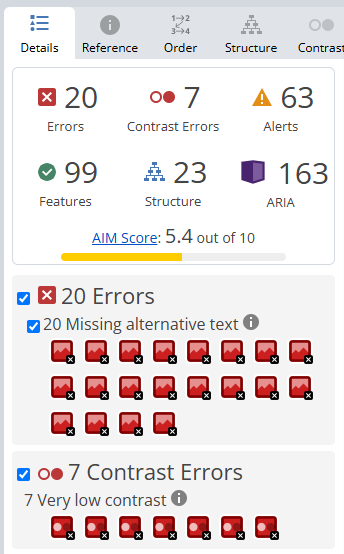
One agency has over 27 errors, with 60+ alerts (possible issues) on their homepage
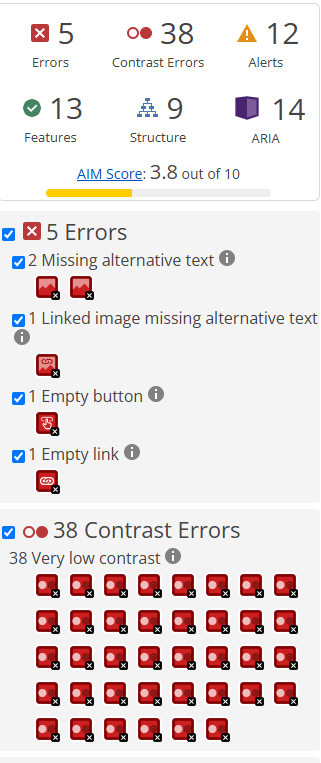
Another agency only has 5 various errors, but 38 contrast issues on their homepage
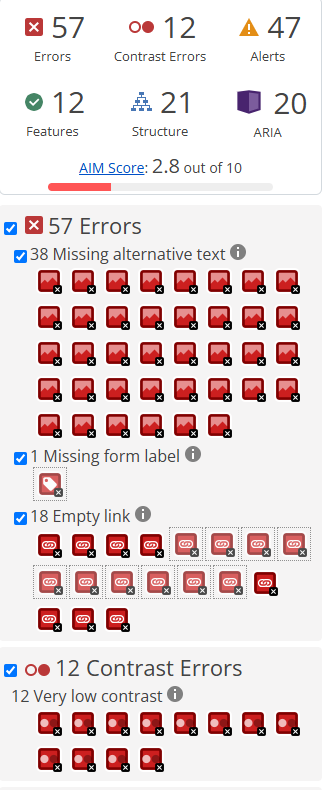
This agency has a whopping 57 various errors, many of them missing ALT text, and 12 contrast issues on their homepage

This agency claims to meet ADA, but has 2 errors and a massive 65 contrast issues on their homepage. They score only 3.4 out of 10.
And because I am fair, if you run Captain Coder’s homepage through WAVE, you’ll see 0 errors and a few alerts, but the code behind it works perfectly for a screen reader:
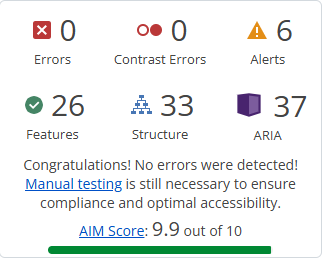
Using an accessibility scanner isn’t a perfect solution. Many agencies make choices with their own websites that they would not for the ones they build for others. It is, however, a great starting point to see if who you are looking to hire actually understands accessibility basics.
No one that does accessible web design for real would tolerate 5+ errors on their website.
Just Hire Captain Coder
Of course, if you are in Wichita and looking for an accessible web design company, you can just hire Captain Coder.
We not only create custom websites that elevate your online presence, but we follow WCAG 2.2 Level AA on every single one.
A beautiful accessible website starts with the right strategy, strong content that attracts your ideal customers, and a great user experience to increase conversions.
Get a design built for your brand that does not exclude any of your audience from your website. Want to know what the process looks like? Schedule a free call to get started.